TPE filament
Thermoplastic elastomer
TPE is the broad family of rubber-like filaments. Filaments sold as TPE are usually softer and stretchier than TPU, which makes them good for grippy, squashy parts but harder to print.
13 TPE filaments from 9 brands, in 41 colours.
At a glance
Our rating- Ease of printing
- Toughness
- Stiffness
- Heat resistance
- Outdoor and UV
- Flexibility
- Dry before printing
Typical settings
Median values across all TPE filaments. Always check the maker's recommendations for a specific filament.
- Nozzle
- 210–240 °C
- Bed
- 30–60 °C
- Density
- 1.20 g/cm³
- Max drying temperature
- 60 °C
Diameters: 1.75 mm (41 colours)
Colours
Popular TPE filaments
Browse all 13-
10 colours
FilamentPM
Flexfill TPE
-
4 colours
FilamentPM
TPE 88 Rubberjet Flex
-
3 colours
CC3D
TPE
-
3 colours
COEX 3D
Coexflex 30D TPE
-
3 colours
COEX 3D
Coexflex 40D TPE
-
3 colours
COEX 3D
Coexflex 60D TPE
-
3 colours
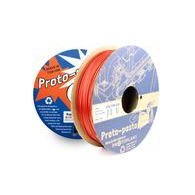
Protopasta
TPE
-
2 colours
eSUN 3D
TPE-83A
-
2 colours
FilamentPM
TPE 32 Rubberjet Flex
-
2 colours
Francofil
88A TPE
-
2 colours
Recreus
Sebs Filaflex TPE
-
2 colours
Sakata 3D
Sakata 3D FleX-920
-
2 colours
Verbatim
Tefabloc TPE
Top TPE brands








About TPE
Properties
- Soft and very flexible, often with a rubbery, grippy feel.
- High elongation: parts stretch a long way before tearing.
- Hardness varies widely, shown on the Shore A scale; lower numbers are softer.
- Usually less abrasion resistant than TPU.
Good for
- Soft grips, handles and feet
- Seals, gaskets and flexible covers
- Stretchy straps and toys
Less suited to
- Bowden printers and fast printing
- Parts that need to hold an exact shape
- Hard-wearing parts, where TPU lasts longer
Printing tips
- Nozzle around 200–230 °C and bed around 30–60 °C.
- Print slowly with a direct-drive extruder and a fully constrained filament path.
- Use little or no retraction.
- Dry before printing if it strings or bubbles.
TPE questions
What is the difference between TPE and TPU?
TPU is a type of TPE. Filaments sold as TPU are usually firmer, tougher and easier to print; filaments sold as TPE are often softer and stretchier but harder to feed. See TPU vs TPE.
Is TPE harder to print than TPU?
Usually, yes. Softer TPE buckles more easily in the extruder, so it needs slow speeds, a direct-drive extruder and little or no retraction.
Can I print TPE on a Bowden printer?
It is very difficult, because soft filament buckles inside the long tube. Use a direct-drive extruder, or choose a firmer TPU around 95A.
How soft is TPE?
It depends on the grade. Check the Shore A hardness: around 95A is firm, 85A is soft, and anything lower is very soft and stretchy.
Is TPE good for grips and seals?
Yes. Its soft, rubbery feel makes it good for grips, handles, feet and seals. For parts that wear or rub, TPU lasts longer.